
Our habits change us

I read a science article this week that said we are completely different at age 77 than we are at age 17. I found that hard to believe. Inside, I feel like I’m the same “me” I’ve always been; it’s just the circumstances around me that have changed.

But when I think about how much I’ve read. And how much I’ve learned. And how differently I think now than I did growing up, I get the change. Maybe it’s just my energy and core interests that are the same.

So here’s what I think is important: If we’re completely different, then other people are too. And how often do we recognize that? When someone you’re close to changes, do you accept it? Or do you hold onto who you think they are, to the person they used to be? Continue reading
All magic – and no magic potion

I was giving a talk this week on Organizational Zen and asked the participants to jot down what their intent was for attending. There are a couple of things I like about focusing on intent.

  • When you have a clear picture in your mind of why you’re doing something – whether it’s working, going to a meeting, taking a class, or having a conversation with an old friend or with a complete stranger – you listen differently. When you know what you’re looking for, you’re more attentive which makes whatever you’re doing a great use of your time. As Eckhardt Tolle says, whatever you’re doing now is the most important thing you can be doing. So choose with intent, and then show up.
  • When you don’t have a clear picture in your head of why you’re doing something and can’t for the life of you remember why you chose to be there – leave. This probably isn’t a great use of your time. Even if this is something you used to love, if you feel your energy drain even thinking about participating, it’s time to do something else.
  • When you don’t have a clear picture in your head of why you’re doing something AND you feel in your gut that this is meant to be – stay put. There’s magic at work.

Continue reading

10,000 hours

Malcolm Gladwell describes “outliers” as people who are at the ends of the spectrum – the few who stand out for their artistic success, their business acumen, or their athletic achievements. His book, Outliers, studies these winners like scientific specimens and comes to an awesome conclusion: to be successful in any field, you need smarts. You need opportunities. And mostly, you have to work hard. Really hard. Like “10,000 hours” hard.

Great artists, successful business people, and uber-athletes make what they do seem easy. It’s not. Yes, there are savants, but to be a success in any field, you have to be intentional about the work you choose to do. You have to stay focused. You have to prioritize getting your work done.

And you put in those 10,000 hours to get really, really good. Continue reading

Exploring the power of a connected community

I’m working my way through Thomas Friedman’s book, Thank You For Being Latefor the second time in as many weeks, and am struck by the immense power of a connected community.

  1. The amount of digital information you can learn from a computer with internet access is unlimited – with free on-line classes at Khan Academy or YouTube. Through free podcasts. By taking a MOOC (mass on-line class). Using search sites like Google. Or reading newspapers from around the world.
  2. You can join a conversation of millions through social sites like Twitter, Facebook, Instagram, or Pinterest, to effortlessly share ideas, businesses, products, and friendships with strangers from around the globe.
  3. There are no gatekeepers in an open, digital world for anything you want to create and share: products, books, music, videos, classes, and ideas.
  4. The largest hospitality group, Airbnb, owns no rooms. The largest transportation company, Uber, owns no vehicles. The largest retailer, Amazon, owns no stores. The largest content provider, Facebook, owns no content. What each group owns is a terrific, helpful vision, great software, and a global connection through the Cloud. You don’t have to own anything to have a thriving business.
  5. If you need cash for a start-up, crowd-sourcing has become business-as-usual through sites like Kickstarter, Indiegogo, and GoFundMe.

Continue reading

Finding energy balance

I just finished reading one of Cesar Millan’s books on understanding dogs and was struck by this idea: When you’re choosing a dog, you’ll be happier in the long run not by picking a certain breed, but by picking a dog that matches your energy. I was helping place puppies last weekend at the Animal Refuge league and offered this advice to a number of folks looking at puppies – some of whom were mellow and others rowdy – and it seemed to help our visitors choose a puppy that was a good “fit”.

Afterward, I got to thinking about how this same energy assessment applies to work. If you’re at a company where everyone works 60-70 hours a week and you like spending less time at work and more at home, good luck feeling in balance. Conversely, if you have a job that requires you to sit all day and you’re high energy, you either sit and aren’t happy. Or you’re up and around all the time making it hard for others to work! I felt this when I worked for a big company that was all about the status quo when I wanted to try new things, to create change. It was a bad match! Continue reading

10 tips for healthy eating

What you eat is at the core of how you feel. And how you feel has a direct impact on your ability to get good work done.

If you’re looking for healthier ways to eat this year, here are 10 ideas to get you started. Continue reading

What is the Universe trying to tell you?

If you want to do really good work it helps to understand how you tick.

  • What do you love to do?
  • What attracts you?
  • What repels you?
  • What motivates you?
  • What do you like to think about?

If you want a snapshot of this that comes right from your gut, try making a soul collage.

You’ll need a few supplies: Continue reading

Take a breath

I’m loving listening to Sharon Salzberg’s free daily meditations this month. I met Sharon in 2007 when she was speaking at an Omega Institute Conference in NYC. Of all the classes I took that weekend, Sharon’s is the one that has stayed with me the longest. Sharon lives a Zen life, and her advice and teaching are always about finding the middle path – not too relaxed and not too tense!

In her meditation prompts this week, Sharon focused on breathing, something we barely notice and yet… try not taking a breath! I start each of my talks on Organizational Zen with quiet breathing. This is a great way to help you feel focused. And I like how even five minutes of quiet breathing helps transition you from one space, or project, or idea, to another.

Here are a few of Sharon’s exercises to get you breathing. Start each of these sitting quietly in a comfortable chair or on the floor. Make sure your back is straight. There’s something magical about having a straight back when you breathe. Your backbone is like an antennae to the Universe! However you sit, you don’t want to feel either too tense or too relaxed. You want to feel attentive and alert. Continue reading

Living a hygge life

There are so many ways to get good work done. Getting grounded in a hygge atmosphere can bring you back to simple pleasures in life that are easy to miss in our over-planned, e-driven world. Hygge (hoo-gah) is a Danish word that has many, many layers – each one more inviting than the next.

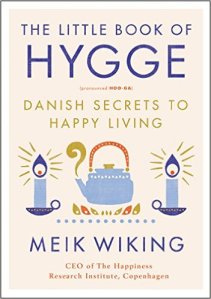
little-book-of-hyggeI just finished reading Meik Wiking’s Little Book of Hygge. Here is Mike’s “Hygge Manifesto.”

How many of these elements can you invite into your life, praise them for being in your life, and talk about how cool they are to have in your life?

Atmosphere
Create an atmosphere at home and at work that’s warm and inviting. With lamps that create pools of light. Candles. Great music mixed with times quiet enough to listen to the weather outside. Natural wood and colors. Vintage furniture. Plenty of books. Plump pillows. Continue reading